
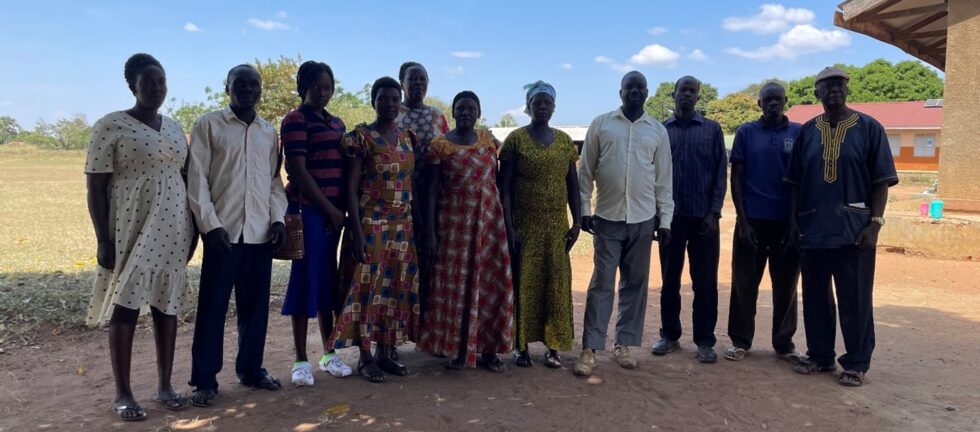
“Everybody is equal. A child with a disability if taught well is more clever than the child without a disability.”
Zakeo Taka Taka

Children with disabilities rarely get the chance to go to school because of their disability and the societal myth that they will not amount to anything even with their education. Nonetheless, a few parents of children with disabilities at Paipir Primary School made the choice to educate their children regardless of their disabilities and the societal beliefs.
Mr. Okello Vincent, a parent of two children with different disabilities (hearing impairment and physical disability) said, “everybody is equal. A child with a disability if taught well is more clever than the child without a disability. An example is Agnes (Program officer), she acts as our role model”, while Mr. Zakeo Taka Taka, a parent of a child with a hearing impairment believes that children with and without disabilities deserve equal rights. “We want them to study because we want to give them equal love. Everybody has equal rights, a disabled child when he has gone to school and studied, it is easy for him to take care of himself once I the parent are not available.”
Ease of access to employment was the reason for Mr. Lakwiya Jimmy, a parent of a child with a hearing impairment and Ms. Lalam Margaret, a parent of a child with a visual impairment. “I want this child of mine to study because I see that it is very easy for her to get a job when she is educated” and “I want them to study because tomorrow, they may have a bright future. They will not have much problem compared to those ones that have not gone to school.”
For Ms. Apio Rosemary, the wish for her child to be social and self-reliant encouraged her to take her child with a hearing impairment to school. “We as women love children so much and taking them to school is to enable them become self-reliant, social and takeaway aggression after interacting with children with different disabilities”, she said.
Despite their decision to educate their children with disabilities, the parents shared some of the challenges they confront in raising their children. The lack of protection while at the school rose as a challenge for Mr. Zakeo Taka Taka, whose child has escaped from school numerous times. “The way he studies because the school is not fenced. He has escaped from school so many times.”
Poor knowledge of Sign Language by the parents is a communication challenge for the parents of children with hearing impairments. “It is difficult to tell even when he is severely sick. You notice when he is bedridden,” and “it is difficult to keep children with hearing impairment because of the communication gap. Also, the use of sharp objects to gain the attention of learners with hearing impairments by their peers’ breeds aggressiveness. “One time, my daughter was walking, and I wanted to talk to her. A friend picked a stone and threw it at her to get her attention”, shared Mr. Lakwiya Jimmy, a parent of a child with a hearing impairment.
Ms. Lalam Margaret, a parent of a child with visual impairment shared that the repetition of class for her child because of his visual impairment was a source of worry especially since the school lack the resources to afford the necessary equipment for learners with visual impairments. “The Braille machine they have to use is not there. No teacher can handle him, and he keeps repeating the class. The child is not happy always because of repeating class.”
Paipir Primary School is one the schools that pledged to increase on the enrollment of children with disabilities in Pader district which is part of the target participants by the OSIEA funded project Strengthening Structures and Institutions to End Gender Based Violence against Girls and Women with Disabilities in the Pader and Koboko Districts.